Thumbs down.
That’s been the consensus on the Jimmy Carter presidency for more than 25 years.
Nevertheless, I liked the man despite his short-comings in office. The lively strength of his mother, Miss Lillian, and the gracious intelligence of his wife, Rosalynn, told me plenty about him and his own self-confidence.
When Jimmy Carter was president — 1977-1981 — I was self-absorbed with projects and plans that only a 30-something single woman swimming with the exciting current of the liberation movement could conceive.
Looking back on the Carter years, what I remember most of all was his message that the United States cared about human rights.
I also cared about human rights. As a Christian from Kalamazoo, Michigan, (the very buckle of the MidWest Bible belt) I grew up in a family and community that emphasized caring for the poor, the hungry, the homeless, the destitute. Because of that, his message seemed common to me and unremarkable.
Little did I realize then how extraordinary his voice was in the violent world of political power where bombs and missiles hold more value than human lives, and where ideals are no more than hot-air used to manipulate the masses, not basic principles of public policy.
Not since Jimmy Carter occupied the oval office, have integrity and decency been such hallmarks of the presidential character. His emphasis on human rights at home and abroad set him (and our nation) apart.
Still, the general opinion on his presidency to this day is a thumbs down.
His post-presidency is another story, however. Most Americans know about Carter’s work with Habitat For Humanity. Some know of his Carter Center in Atlanta, and its international work to eradicate illnesses such as guinea worm. People around the world know that Carter received the 2002 Nobel Prize for Peace.
But not everyone realizes that Jimmy Carter teaches Sunday School at his church in Plains, Georgia. From the moment I learned about his Sunday School class, I wanted to attend.
My husband and I decided this was the year. Sunday morning, Oct. 12, 2008 found us at the church.
Maranatha Baptist Church is nestled among pecan trees, on Highway 45, not far from downtown Plains, a town with a population of 630.
The town and the church are surrounded by peanut fields, corn fields and gently rolling cotton fields. The high school where Jimmy and Rosalynn attended is still the high school for local teens.
Jimmy Carter has been teaching Sunday School at Maranatha Baptist Church since 1981. On the Sundays when he teaches, the church can be full to overflowing. Church membership is about 40 families, but sanctuary pews hold 150, and there is an overflow room with big screen TVs that can accommodate another 300.
I did not want to sit in the overflow room, so was at the front door, along with about 23 others, when it opened at 8:30 a.m. an hour and a half before Sunday School would start.
First task, a thorough search by the Secret Service.
Second task, find a pew. We were in the center of row two.
The sanctuary is pale green, with green carpeting and cranberry red pews. It is modest yet serene.
Within half an hour the church is half full and the people keep coming.
About 9 a.m. the church pastor welcomes us, and a former pastor, Dr. Dan Aerial, talks about Carter’s class. “You are part of the mission of this congregation,” he said. “We have had as many as 28 different foreign countries represented here on a Sunday.”
He tells us we can take pictures of Jimmy Carter when he first comes out to talk with us, but once he starts his Bible study we must remember that we are in the house of God, here to learn and worship.
“He will apply the lesson to life. He’s a good Bible teacher,” Dr. Aerial said. “He just turned 84 years old. After the service he and Rosalynn will stand for photos. It is amazing that week after week he will stick around for photos.”
Dr. Aerial explained that the women in the church organized the photo sessions with great precision, to get everyone through and out the door as quickly as possible. “So it’s important to follow their directions exactly,” he says.
And then, Jimmy Carter is standing right in front of us. He’s 5’ 9” with perfect posture, snow white hair, clear skin and piercing blue eyes. His soft, familiar voice with its gentle Southern accent is carried by a lapel microphone.
He asks where we’re from, and there are people from South Africa, Trinidad, Texas, Arkansas, Florida, Alabama and Georgia. I say “Angels Camp, California.” He looks at me with an amused smile. “Angels Camp, California” he repeats. I suspect he will go home after church and look up where Angels Camp is.
He is wearing black trousers, a black and white suit coat, a light blue shirt and a bolo tie. He says he was in Cyprus last week.
“When I was elected, church bells rang all over Cyprus and Greece,” he said. “But I was not able to bring peace to the factions there. Now there’s a good chance because the leaders of factions are both devout Marxist Communists. So there is some common ground on which to build.”
I marvel that he can see promise for peace in the fact that both factions have devout communists for leaders. For him that fact was hope-filled. I suspected that for the current administration, it would be a fearsome threat that might need military correction.
He said he was one of 12 World Elders, leader who are no longer in political office, who are willing to help work for peace anywhere in the world.
“So we went to Cyprus last week to encourage peace talks, to bring peace to the Republic of Cyprus,” he said. “Cyprus is mentioned 8 times in the New Testament.”
How smoothly he moves from the world stage of today to the Biblical lesson.
The lesson, from the Book of Acts, Chapter 6, is about the growth of the early church, its persecution by the religious powers of the day and its expansion throughout the Mediterranean area. He is eloquent, comfortably at home, walking across the front, to the podium, and back, asking questions and discussing answers with members of today’s class. He speaks without notes, smiles often and seeks connections with members of the class.
He keeps his eye on the clock at the back of the church.
After 45 minutes, he winds up the class asking, “What do we get out of today’s lesson that we can apply to our every day lives?” One was that “If we take a firm stand for Christ, following His pattern of humility and service, we cannot estimate the power and impact that we will have.”
And then he is gone, out a side door.
There is a 10-minute break between Sunday School and Church. I walk to the women’s room. There is Rosalynn, just outside the door, talking with a woman. Her voice is melodious and as soft as Jimmy’s.
Before returning to my pew-seat, I look at the wooden offering plates sitting empty on a table at the front of the sanctuary. A women sitting near us, who had come here before, told me that Jimmy Carter hand-crafted the plates and if I turn one over I can see his initials carved in the bottom. I do, and see his initials– J. C.– carved there.
Church is another inspiring event. The speaker, Dr. Loyd Allen, professor of Church History and Spiritual Formations at the McAfee School of Theology, discusses Christian Freedom and the separation of Church and state.
After the last song is sung and the benediction, we are asked to sit down.
“Those of you who do not want your photo taken with the President and Mrs. Carter may leave now,” the pastor says. No one leaves.
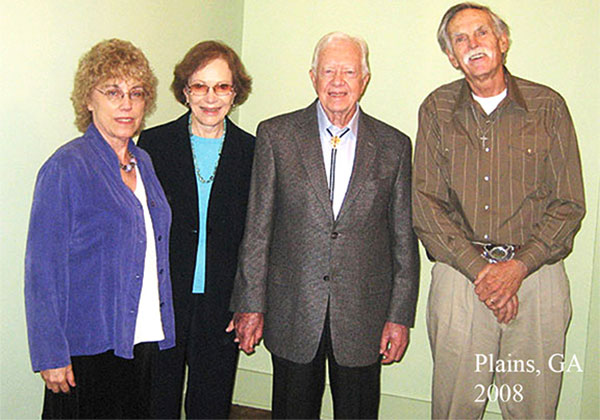
He then tells us to follow the women’s instructions. We are to take everything — our Bibles, jackets, cameras, purses, etc.– and get into line. Jimmy and Rosalynn are standing in the vestibule of the church.
“When you are at the head of the line, give me your camera,” says a woman. “Then go stand next to the Carters and I’ll take your picture and then you go immediately out of the church.”
Al and I are with a friend from Atlanta. She and I decide that we do not want to stand with the president with our arms full of stuff. So she agrees to hold all our stuff while we get our picture taken, and then I’ll take everything from her including her stuff, and she can go get her picture taken. It’s a perfect arrangement.
When our turn comes, I stand by Rosalyn and put my arm around the petite lady. Al stands next to Jimmy, but is too awed to touch the president.
The flash goes off and I hurry forward to grab all the stuff from my friend.
Unfortunately, we’re not graceful in the transfer, and I hear the church women saying, “No! No You’re holding up the line!” But I can’t stop in the middle of the awkward exchange of stuff.
Then I turn and look at the presidential couple, and they are all alone. No one is standing with them because I’m holding up the line.
They both gaze at me with eyes of tenderness.
“Thank you!” I say, pausing with my mountain of jackets and purses.
President Carter grins and gives me an enthusiastic thumbs up.
Thumbs up!
I fly out into the Georgia sunshine. A Secret Service man looks at me quizzically.
“The president just gave me a smile and a thumbs up,” I say. “I’m SO happy!”
He smiles and nods.
Our friend is right behind us and she and I laugh as we climb in our car. Laugh from the pleasure of listening to Jimmy Carter expound on the world and the Scriptures for 45 minutes and from our embarrassing transfer of stuff.
But most of all I’m laughing for the pure joy of receiving a thumbs up from President Jimmy Carter.