My Sweetheart longed to visit South America. He wanted to practice his Spanish. Wanted to taste authentic South American dishes. Wanted to photograph volcanoes.
The large continent had never called to me, but I love him, I enjoy travel and we aren’t getting any younger, so if we’re ever going to take such a trip we’d better do it now while we can.
In the old days, which is how we refer to our youth, we might have backpacked or buzzed along South American highways on motorcycles, but with arthritis and diminishing mobility, ocean cruising has become our preferred mode of travel. And so we joined a cruise in Seattle that would take us all the way to Rio de Janeiro with plenty of stops at places we’d never even heard of.
And today — Friday, October 5, 2018 — we’re riding a cruise-provided tour bus from Guatemala’s Puerto Quetzal to the mountain town of Antigua, the original Colonial capital of the region. While Antigua may be familiar to many, we’d never heard of the historic city.
When Al and I thumbed through the cruise ship’s catalogue of shore excursions, Antigua grabbed us. It was described as a UNESCO World Heritage site famous for its unique Spanish Mudejar-influenced architecture. (Whatever Mudejar is). The catalogue touted Spanish Colonial buildings, lively markets, chocolate shops, and best of all, three hours on our own to wander with our cameras.
Since the historic area is only about 10 blocks square, we felt we’d be able to see much of it even at our leisurely pace.
During our 90-minute bus ride, we pass sugar cane fields, their tall green stalks forming a vast, rippling sea. We ride by coffee plantations. Our Mayan bus guide, Wilber, says Guatemalan coffee is among the best in the world. We pass black bean fields, where laborers bend to their work. I think of the cans of black beans we buy every week at our local grocery. Perhaps they came from these fields. The workers, in their jeans and hats remind me of U.S. field workers, faithfully picking our produce from sun up to sun down.
When our four lane pavement shrinks to a dusty dirt track and our bus slows to a creep, Wilber says this area was destroyed last June by the Fire Volcano, one of three volcanoes hovering near Antigua.
We crawl through an ashen moonscape. Charred remains of trees spike up through dried gray mud. Inching across temporary metal bridges, I wonder what the chances are that the volcano will erupt again while we’re in Antigua. Al would probably find an eruption exciting. I wouldn’t.
Wilber says there are 21 Mayan languages spoken in Guatemala. He says the first language taught in school is Spanish. The second language taught is the person’s Mayan language. And the third language taught is English.
He then gives us a lengthy example of his Mayan language. It sounds very complex to uninitiated me.
Wilber describes the various markets in Antigua and he lists several museums we can find there: the silver museum, pharmacy museum, Colonial museum, archeology museum, chocolate museum and jade museum. Guatemala is one of only three or four places on earth where jade is mined. Guatemala’s jadeite jade is among the most valuable jade in the world, he says.
We’ll be dropped off and picked up at the Maya Jade Museum.
On the outskirts of Antigua, we change from our bus to a shuttle van. No large vehicles are allowed on historic Antigua’s narrow, cobbled streets.
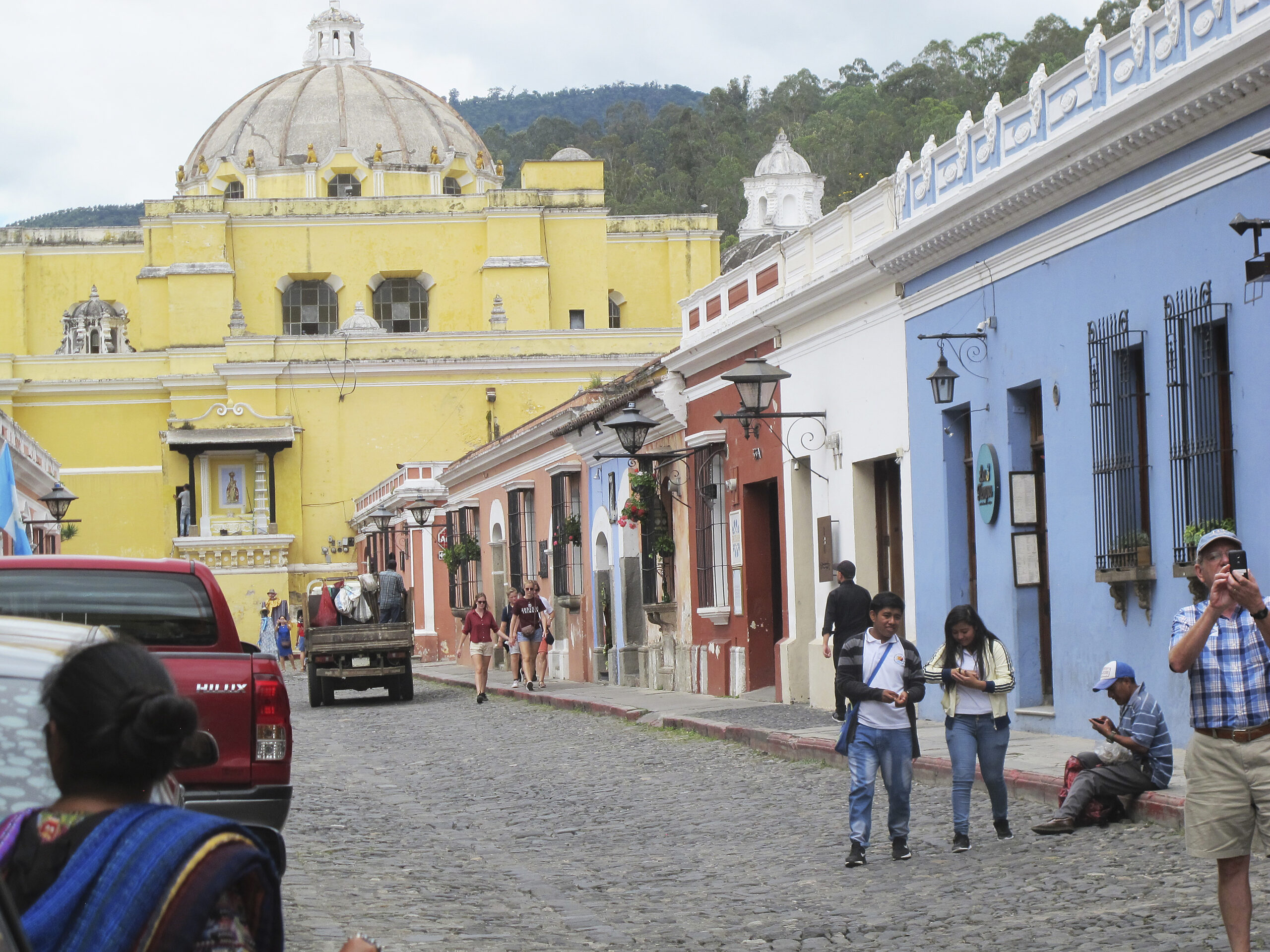
When we saw the description of Antigua in the cruise ship’s catalogue, I pictured tall Colonial houses with bougainvillea-covered balconies. Years ago we’d visited Cartanega, Colombia, a city filled with Colonial-era structures. So I assumed I knew what the streets of Antigua would look like.
But when we climb off the shuttle and glance around, the place is nothing like I’d expected. Nothing like I’ve ever seen before. Squat, one-story adobe houses line the narrow streets in pastel shades of pink and green and blue and orange. They look like rows of dusty jewels to my surprised eyes.
The streets themselves are all uneven stones of different shapes and sizes with little or no earthen pavement between. This is no place for heels or flip-flops. Yet a gentle hush surrounds us. Cars and scooters and three-wheeled tuk-tuks pass silently, no blaring music, no honking horns. We would learn later that horn honking is not permitted here.
Beyond the low, square, colorful homes, forested hills rise like ocean swells. And beyond them, dramatic volcanoes: To the East, Volcan de Agua (Volcano of Water). To the West: Volcan de Fuego (Volcano of Fire) and its dormant twin Acatenango.
Above us, the sky is high and wide and welcoming. A thin overcast keeps the temperature comfortable while hiding the volcano peaks in a cottony haze. The overcast and my large-brimmed, blue sunhat should protect me from sunburn.
Glancing at Sweetheart, I see he’s grinning just like I am. We stroll dreamlike, our eager eyes studying the street, the houses, and the incredibly beautiful mountains beyond.
Turning a corner, we see a two story church. Rising above all the homes, its brilliant yellow facade, like a blast of sunshine, pulls us to it. The stunning church stands at a busy intersection (6 Calle & 3 Av). Its plaster facade of tall curved columns and empty niches seems Baroque-ish to me. Three belfries stand atop, making the beautiful structure three stories high. Adjacent to the church, and equally brilliant in rich yellow, is San Pedro Hospital. Originally built by the Dominican Friars in 1663 for clergy members, today it serves the poor, the elderly, and others in need.
In front of the church and hospital is an ice cream cart. A police woman directs the quiet traffic with quiet hand signals. No whistles blasting through Antigua’s gentle air.
Across the street, a grassy park beckons in flowered bushes, and benches. The place is packed.
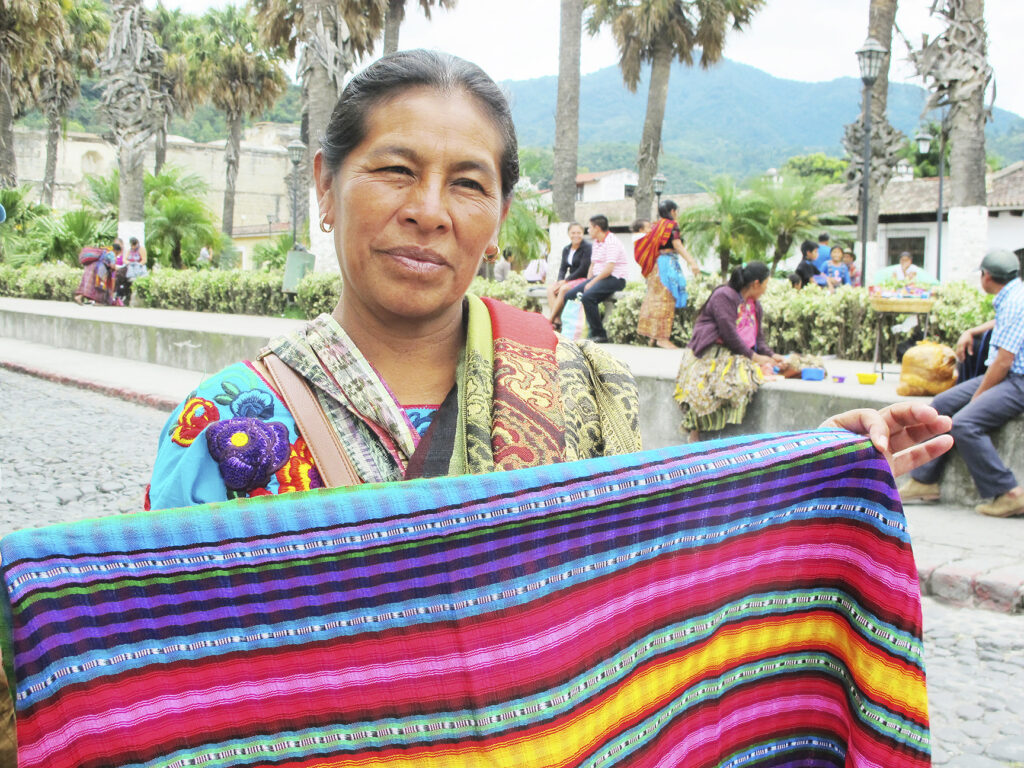
An abundance of children chase each other in circles, their laughter rising like musical bubbles. Older folks visit on benches. Women in colorful garb, their arms full of hand-woven textiles, sit or stand together, obviously street vendors. One approaches me with an armload of brilliant blue and orange table clothes. She says they are $21. A steal. But I don’t wish to buy anything today. I just want to take pictures and soak up the atmosphere.
However, I have a few one dollar bills. I ask if I can pay her a dollar to take her picture, and she says yes. She strikes a pose. I click the camera, give her a dollar, and we’re both happy. I don’t have to carry a table cloth around, and she has a little cash.
The park is bursting at the seams with life. Toddlers tug at their mamas’ skirts. Children beg grandparents for an ice cream. Adults talk together contentedly. It looks like a big family reunion.
At the park’s far end we come upon a structure we’ve never seen before. A long, narrow, open air pavilion painted in the same brilliant yellow as the San Pedro Church and hospital. Seven arches on either side support a sheltering roof. And under each arch stand two waist-high stone tubs. A stone path runs down the middle. What could this graceful structure be?
We take some pictures of it, then turn and photograph nearby ruins. And beyond the weathered, picturesque ruins, another church. Everywhere we look, there’s something beautiful waiting for us to take its portrait.
Have I ever been anywhere like this before — this quiet, time capsule world with neither neon nor stop lights?
When we wander back to the mysterious pavilion, we find the tubs full of water. Turns out this is a public laundry fountain. Yes, people bring their laundry here and wash it by hand. My preconceived image of women washing along a muddy riverbank immediately changes to this delightful gathering place where people can socialize while doing their laundry, fully protected from the sun.
I’ve entered the 17th century. And it feels magical.
We simply wander, filled with wonder. Churches, monasteries, convents … they’re all here. Some have morphed into hotels. Others remain handsome ruins.
We learned from bus-guide Wilber that Antigua suffered many earthquakes over the centuries. In 1773 major shocks hit in June, September, and December destroying most of the capital. The quakes killed hundreds of people and hundreds more perished from hunger and disease resulting from the quakes. Due to the destruction, officials ordered the city to be abandoned, and moved the capital to what is now Guatemala City.
However, there were a few churches and homes that survived the tremors. And many locals did not have the means to move, so Antigua was never totally deserted. And when coffee plantations began springing up in the rich volcanic earth surrounding the city, workers and their families began venturing back.
Today, Antigua glows with warmth and sensuality. And I want to absorb it all.
At the main square, we pause. Tree-lined with plenty of benches, it’s like the other park, teeming with life and light- hearted enthusiasm. Children, teens, young adults and elders all interacting. Talking, laughing, enjoying the afternoon. Judging from a couple tourists working their phones, it’s also a wi-fi hot spot.
A huge fountain dominates the park. The “Mermaid” fountain’s four large females, one on each side, spray streams of water out of their breasts. Al is quite taken by the fountain, and snaps several pictures.
I think it’s a response to all those European fountains with water spraying out of little boys’ penises.
Actually, Diego de Porres, who designed the fountain in 1738, was said to be inspired by the Neptune fountain in Bologna, Italy. His mermaids have had a difficult time of it. They were beheaded a century or so ago to make room for a fountain-top gazebo. Eventually the gazebo lost favor, was removed, and the heads restored. Although the park is off-limits to street vendors, every few minutes a woman selling colorful textiles approaches me, asking if Id like to buy. I decline, but offer to pay her a dollar for her photograph. All but one seem pleased to pose for my camera.
While I don’t speak Spanish, and they don’t speak much English, it’s clear we understand each other enough for our brief interactions. And they all seem polite. I hope I seem equally polite to them.
By now, Sweetheart’s knees hurt and I could use a rest. We find a coffee cafe facing the park — El Portal — and take seats at the counter. Al orders two lattes and a chocolate croissant to share.
As I watch the barista make our drinks, I realize I feel comfortably at home here, and at the same time as if I’m in a world so exquisitely exotic that I can’t imagine what I’ll see next.
The lattes are excellent. The croissant unbelievably delicious. On the bus Wilber said Guatemala is considered the birthplace of chocolate. That’s enough to make me want to settle here for a year or maybe a decade.
Sweetheart strikes up a conversation with the man sitting next to him. It’s in Spanish. Somewhat halting Spanish on Al’s part, but equally enthusiastic by them both judging from their hand gestures.
Finished with my latte and half-croissant, I leave Al to his conversation and wander back to the fountain. A young man approaches asking if I’d like to buy one of his handmade flutes. These elegant wooden instruments are flamboyantly decorated with bright geometric designs. He even plays me a haunting tune. I say, “Gracious. But I have no money for souvenirs.”
He then says, “I’ll trade a flute for your hat.”
I almost laugh out loud. I assure him I need my hat, but offer to take his photo for a dollar. He says yes and I add to my photo collection of these handsome, dignified Antiguans.
Long ago, when Al and I visited Colombia, the street vendors swarmed us like a cloud of wasps, insisting that we buy their wares. I felt attacked as they grabbed my arm and flashed their necklaces in my face. But these lovely Antiguan street vendors with their hand-made textiles and wooden flutes are so courteous that I’d like to give them a hug.
A few minutes later, Sweetheart slips his arm around my waist and says we must see two more sights before heading back to the van. His conversation partner told him the Santa Catalina Arch, an icon of the city, is only about three blocks away. And the famous Lady of Mercy Church is just a block or so from the arch.
“We can’t leave without seeing them,” Al says. And off we go.
The huge saffron arch spans a main thoroughfare: 5 Avenida Norte. If you stand looking due south through the arch, it forms a beautiful frame for the Aqua Volcano. If you go to the other side of the arch, and look north, it frames the dome of Our Lady of Mercy Church. So from either side the view is spectacular.
The arch was built in the 1600s to solve a problem for local nuns. The nuns were part of a cloistered convent and taught school children. Their convent stood on one side of 5 Avenida Norte. The school where they taught was on the other side of the street. Since they were cloistered, the nuns were not permitted to interact with the “public,” so how could they cross the street and still obey their vows? The arch provided the solution. Through it they could move easily between their convent and school unseen by the outside world.
The dazzling arch survived many earthquakes, and in 1850 was reconstructed. About that time, a fancy clock tower was added.
Today the arch remains a stunning reminder of the vital role Catholicism played (and still plays) in this enchanting culture.
I imagine the nuns in their black habits, hurrying like timid rabbits to class each morning, eager to help their students learn and grow. Their spirits linger as we take a few photos and head for Our Lady of Mercy Church.
We’re walking through a city that’s been destroyed by earthquakes, volcanic eruptions, floods, and even deserted by government decree, a city that by all accounts should be nothing but rubble, and it is teeming with life and filled with beauty. It feels enchanted.
Yellow must be the favorite color for churches here. Like San Pedro, The Church of Our Lady of Mercy is sunburst yellow. On a cloudy day like this, the yellow is exceptionally bright.
The church, which continues to hold regular services, is huge. Its fanciful stucco facade incorporates Mayan deities along with Christian symbols. I like that the ancient past of this city continues to thrive within its present.
This massive church was built in 1749, designed by architect Juan de Dios Estrada. Taking into account the frequency of earthquakes, he lowered the roof and two bell towers, designed thick, heavy walls, reinforced with buttresses. Windows were small and placed high on the walls. Concentrating the structure mass low like this, insured that the church would withstand tremors. And it did.
Due to his wise design, the church survived the destructive quakes in 1773.
However, when authorities ordered Antigua abandoned, priests and congregants gathered up the church’s precious works of art, and moved with them to what is now Guatemala City. Stripped of its statues and paintings, the church stood empty and idle until 1853 when restoration work began.
Today it appears very much as it did in the 1700s. Except, of course, for the street venders and ice cream carts out front.
I would later learn that this low, thick design using bricks and other local materials is Mudejar construction.
As we head back toward our waiting shuttle van, the streets feel much more crowded. And since we’ve just sort of wandered, letting our hearts pull us along, I’m not totally sure how to get back to the jade museum.
Since Sweetheart has an excellent sense of direction, I follow his lead. But this seriously photogenic jewel of a city stops me every few minutes with its amazing beauty.
We turn a corner and there is the most dramatic ruin I’ve seen today: Nuestra Senora del Carmen Church. I can’t take my eyes off it. It rises above everything. Huge columns at least three stories tall rise in beige and brown. Built in 1728, it was destroyed by the earthquakes. It looks like something out of a fairy tale.
As I stare, enthralled, a young woman with a load of textiles approaches me, asking me to buy. My dollars are gone, and I have nothing to offer her, so I simply decline.
But she presses me. “Only 21 dollars,” she says.
“I don’t have 21 dollars,” I say, smiling. Al is photographing this amazing ruin, the filtered afternoon light pouring through what once was its roof.
“For you, then 10 dollars,” she says.
I shake my head. “I don’t have 10 dollars,” I say.
She draws very close and whispers, “I take Visa.”
Our eyes meet and we both burst out laughing. For three hours I’ve been spell-bound by the embrace of the 17th century, and with three whispered words, this Mayan woman snaps me back into the present.
The spell is broken.
Those who study such things say that travel is good for the body and the mind. They point out that most people get more exercise when they travel than when they merely stay home, and that experiencing unfamiliar sights, sounds and tastes keeps the brain sharper than simply repeating daily routines.
After three magical hours barely skimming the surface of Antigua, I’ll add that travel expands the soul. I shall carry this amazing city with me for the rest of my life.